
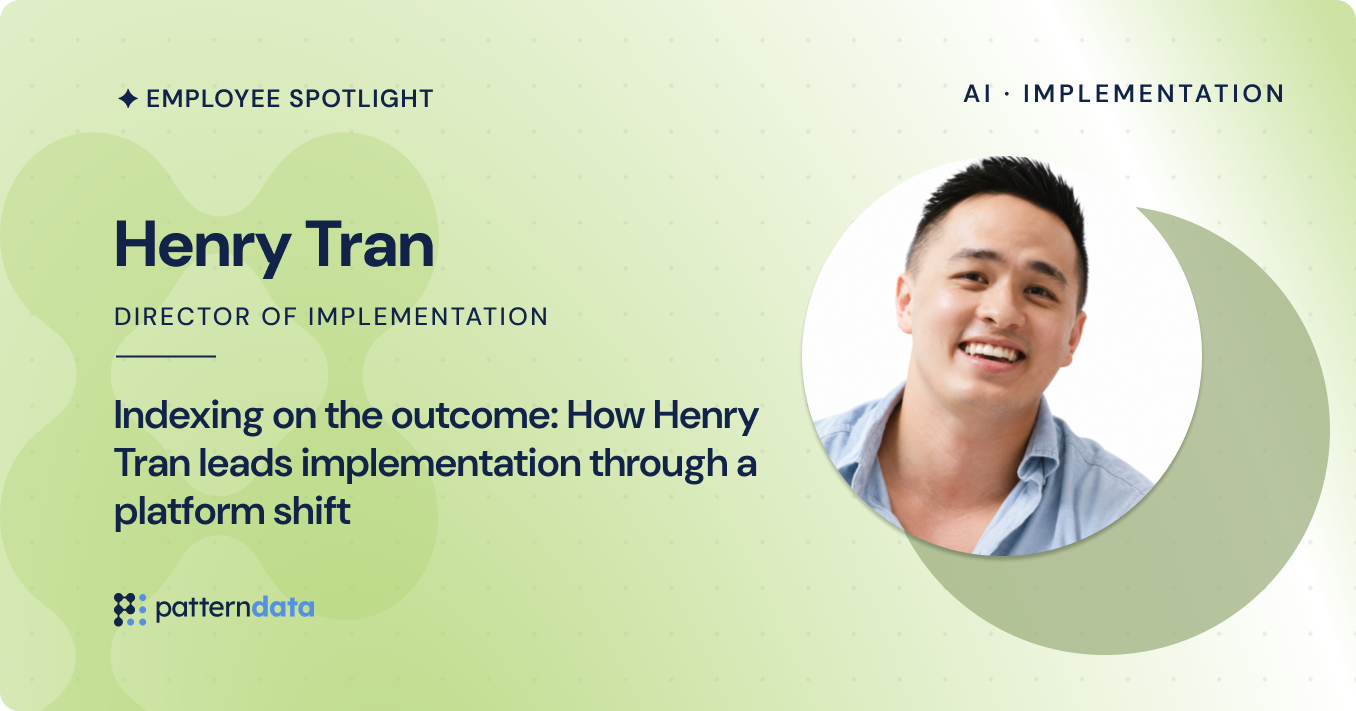
When Henry Tran talks about his team, he keeps returning to one distinction: the task and the outcome.
It is what he tells them directly. "I don't want you guys to index on a task. I want you to index on an outcome."
As Pattern's Director of Implementation, he has spent much of this year rebuilding how his team understands its own work, and he is candid that the shift is harder than it sounds.
From autonomous vehicles to mass torts
Henry spent five years doing data analytics at an autonomous vehicle software company before joining Pattern in late 2022. The company he left had 2,500 people. The one he joined had about ten.
He came in as a data engineer, responsible for ETLs, reporting infrastructure, and moving data from the database into the platform.
"What got me really excited was I had individuals that quite literally were leveraging AI in ways that were actually helpful," he says. "To actually help this information get claimants the justice that they need was pretty exciting."
Within a year he was leading analytics. Today his team spans AI solutions, analytics development, medical review, and deployment infrastructure.
Knowing what is not there
Ask Henry to define analytics without the jargon and he starts with the word itself.
"Analytics at the crux of it is kind of an intimidating term, because we immediately think of data and technology and computers," he says. "It's really about taking the things you can measure and curating a story around them."
When he started, that story was thinner. Pattern could extract what appeared in the documents: a diagnosis, a date, a family history. Firms received the extraction and worked out the implications themselves.
"What we learned in our experience was that knowing what is there isn't a real challenge," he says. "It's knowing what's not there, and knowing where the areas of improvement and optimization lie."
That reframing now drives the reporting his team builds. Firms see which cases have complete documentation, which have gaps, and which specific issues to resolve across the inventory.
"It's really easy to extract information on a respiratory injury and then relate it to a product usage ten years prior. That's super easy," Henry says. "All the nuance in between is the thing that we really need to surface, and the gaps that we need to surface."
The shift to outcomes
Henry's argument for the change starts with where he thinks the work is heading.
"Task execution is going to get cheaper and cheaper, especially as technology advances," he says. "What's going to be actually valuable isn't 'I can do the thing.' It's: evaluate if that thing is right. Can I communicate that very efficiently and effectively? Can I document that?"
Applied to his own department, that means retiring an old job description.
"In analytics, traditionally you'd be like, oh, your job is to write code, build pipelines, build reporting, and then you're done. That's your job," he says. "But the real job now is: are you building a data product that can solve a problem? Can you identify that problem? Are you making the claim review faster?"
He is direct about why people find it uncomfortable. "When you have tasks, the completion criteria is very straightforward. You do the task, you're done," he says. "If you're saying create value, like, what is value? What is the thing that someone needs? What is the problem that we're actually trying to solve?"
He points to the moment it landed for one of his analytics developers, when the team moved from building around a litigation to building around the people using the software.
"She said it's the hardest hitting 'duh' that I think I've experienced," Henry recalls. "Obviously we're building this software for people."
Taking down the silos
The old operating model ran on handoffs, and Henry describes the cost plainly.
"In the past, it very much so was: I did my job, here's the handoff, I'm done," he says. "What that creates is an environment of lack of accountability. I have this sliver of the operations that I'm responsible for, and t hat's it. That's my job. And that really is isolating."
The consequences surfaced late. "At the end, we're like, oh wait, we missed a core piece of the litigation logic, or this could have been a better user experience. Why didn't we do it this way?"
His team now organizes into pods built around outcomes rather than task lists. People move between them, and leadership protects their time.
"We all have this shared outcome, which is build a good review experience," he says. "That is just a shared thing in common English that we can kind of point to."
The team mixes litigation managers who trained as lawyers and paralegals with developers who build pipelines. Henry's approach to getting them speaking the same language is to hand them the same problem.
"If we get them to solve the same problem and we use the same language to solve that problem, then the osmosis of knowledge is much more natural."
Some of what follows he did not plan for. "I have AI solutions analysts right out of college that now are medical document experts. I have analytics developers that know master settlement agreements better than any lawyer that we've ever worked with."
Collaboration at a distance
Pattern's team is distributed, and Henry calls deep collaboration one of the harder things to sustain that way.
The team once tried optimizing meetings away in favor of written updates. "Efficiency for efficiency's sake tends to lead to poor quality and bad results, and I do believe it's because of the lack of proper communication," he says.
The default now is a call. "If you need something, call me. Get me on the phone. I don't want a ten page document of you describing something."
He sees a related risk in leaning on AI to do a person's thinking out loud. "If I'm communicating poorly to an AI, they're not going to give me the feedback I need to improve in my communication. That needs to be with people."
Henry splits his time between home and Pattern's Pittsburgh office, one of three company locations. He is careful not to oversell what that does. "Remote has its benefits, but I do think it presents its own challenges," he says.
Having somewhere to sit down together helps. One conversation in that office produced the shared vocabulary his team now uses across disciplines.
What he wants
Asked what he wants the team to be known for, Henry declines the premise.
"I don't really over index on legacy," he says. "I really like just doing things. And I think in a world where there's so much to do, if you can become good at something and deliver on something, that's a big measure of success."
What he will claim is a goal for the people who report to him.
"I want to upskill every single person at Pattern so that these people are equipped and ready for whatever comes in the future."
For the department, the ambition is narrower and more specific. "I really do want us to be known for using AI in a way that actually helps people. Remember that this is a tool that is supposed to help humans."
He is equally clear about the firms Pattern works with, and what their work asks of them. "These law firms that have positioned themselves to do this work, our helping of their mission is something that can't be understated."
Which brings him back to the thing he thinks is easiest to lose.
"It's really, really easy to forget why we do things," he says. "At the end of the day, your relationships, the people you work with, the people that rely on you, your family, your friends, these are the reasons why we do things."
"We want to build a system and a product that has such a tangible positive impact for human beings that it inspires other companies and other businesses and other people to look at their work and follow suit. Because we're all we got."