Key capabilities

How Pattern evaluates Camp Lejeune claims at scale

Pattern structures exposure and injury for every case, evaluates each against both recovery tracks, and carries validated data forward as criteria change.

Exposure verification
Establish base presence

Pattern reads DD-214s, service records, housing and base assignment records, and VA records, then calculates cumulative exposure days and places each claimant in the EO duration tier. When the only support for base presence is an affidavit, Pattern flags it and identifies which cases lack official records.

Injury validation
Validate each injury

Each injury is assessed on its own entry. Pattern places the EO tier, checks the latency window against first exposure, last exposure, and diagnosis date, confirms CKD stage, and prompts for systemic or localized scleroderma, so a claimant with several injuries has each one documented against its own records.

Both recovery tracks
See both recovery tracks

The Elective Option and the litigation track draw on the same facts. Pattern holds both in a single case view, with the criteria for each track applied to the same record.

Directed workflow
Directed workflow

Open items surface inside each claimant profile and roll up across the inventory by severity, covering missing exposure dates, latency gaps, CKD staging, scleroderma form, and death documentation. Reviewers see what is missing or inconsistent and why, and the team sets the order of work.

What Pattern captures from a Camp Lejeune case file.

Each value links back to the record it came from, structured against the criteria for each recovery track.

DD-214s and service records
Exposure dates and cumulative days
Housing and base assignment records
Qualifying injury and EO tier
Diagnosis dates and latency window
CKD stage at diagnosis
Systemic or localized scleroderma
Treatment history and severity
Death documentation

The platform

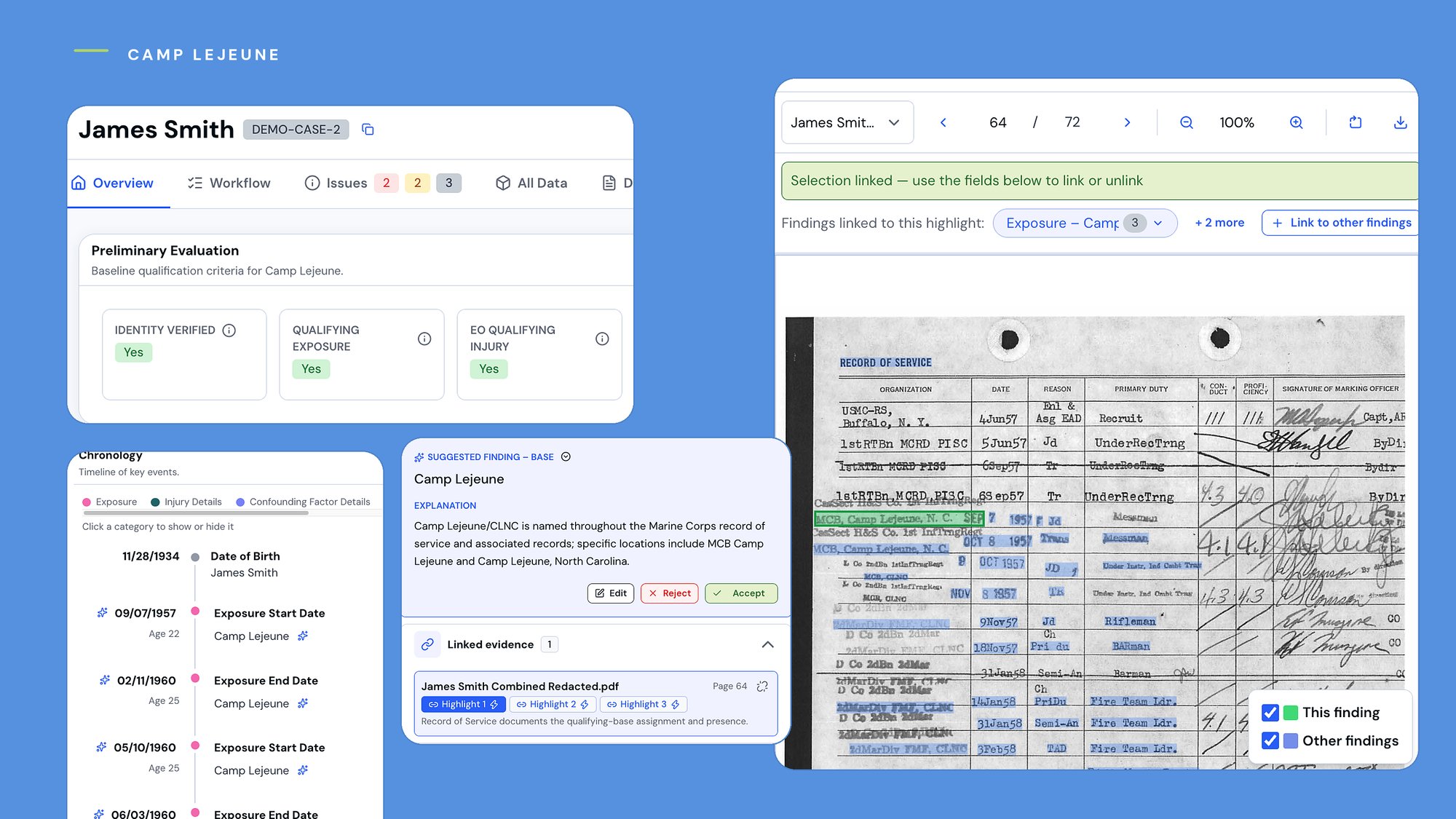
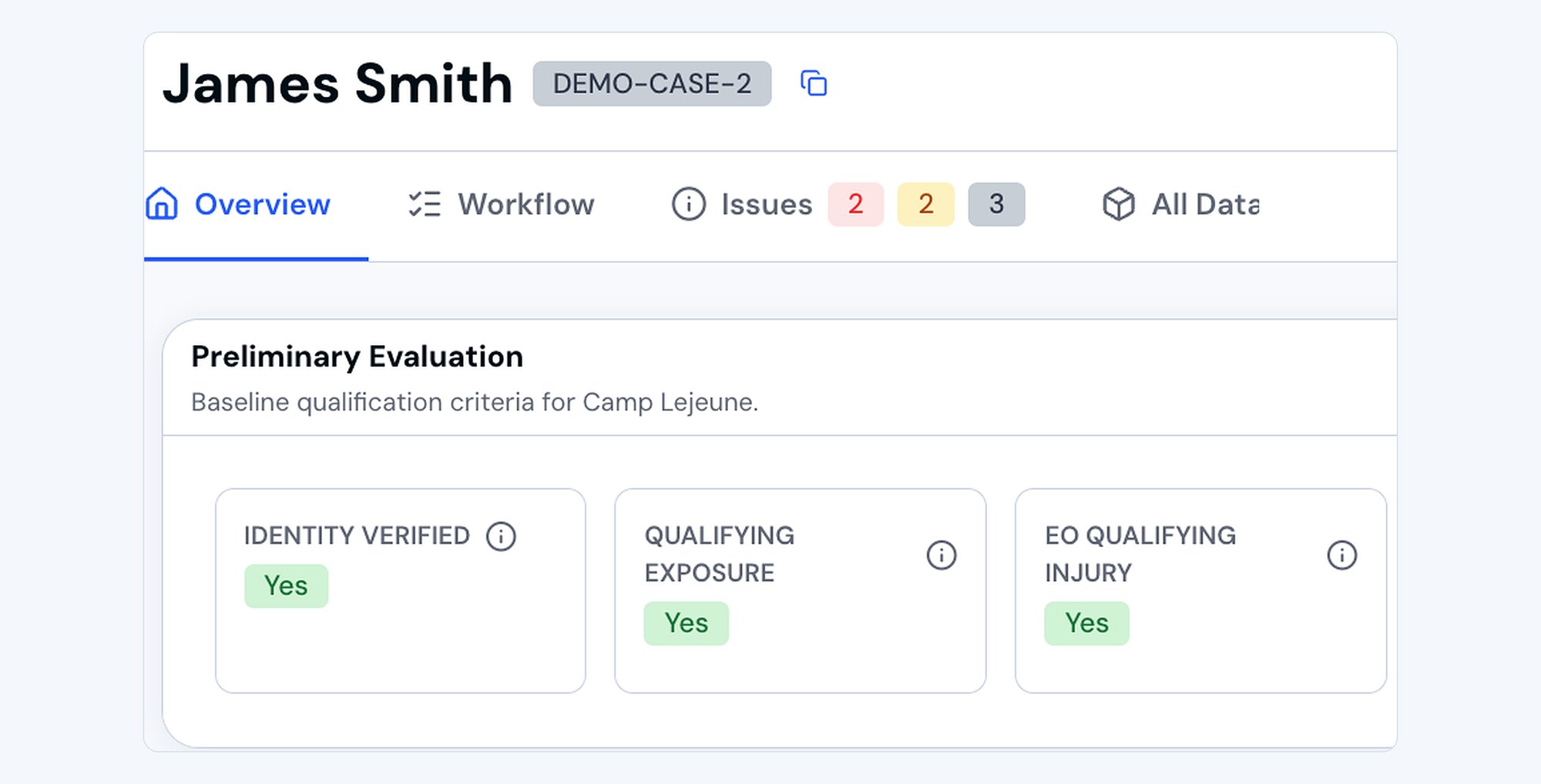
Camp Lejeune case file showing exposure, injury, and latency gates in a single view
One case file for both tracks

Every Camp Lejeune case opens to one file that holds exposure, injuries, latency, and treatment together. Reviewers see the facts behind both recovery tracks in one place, working from the same structured record.
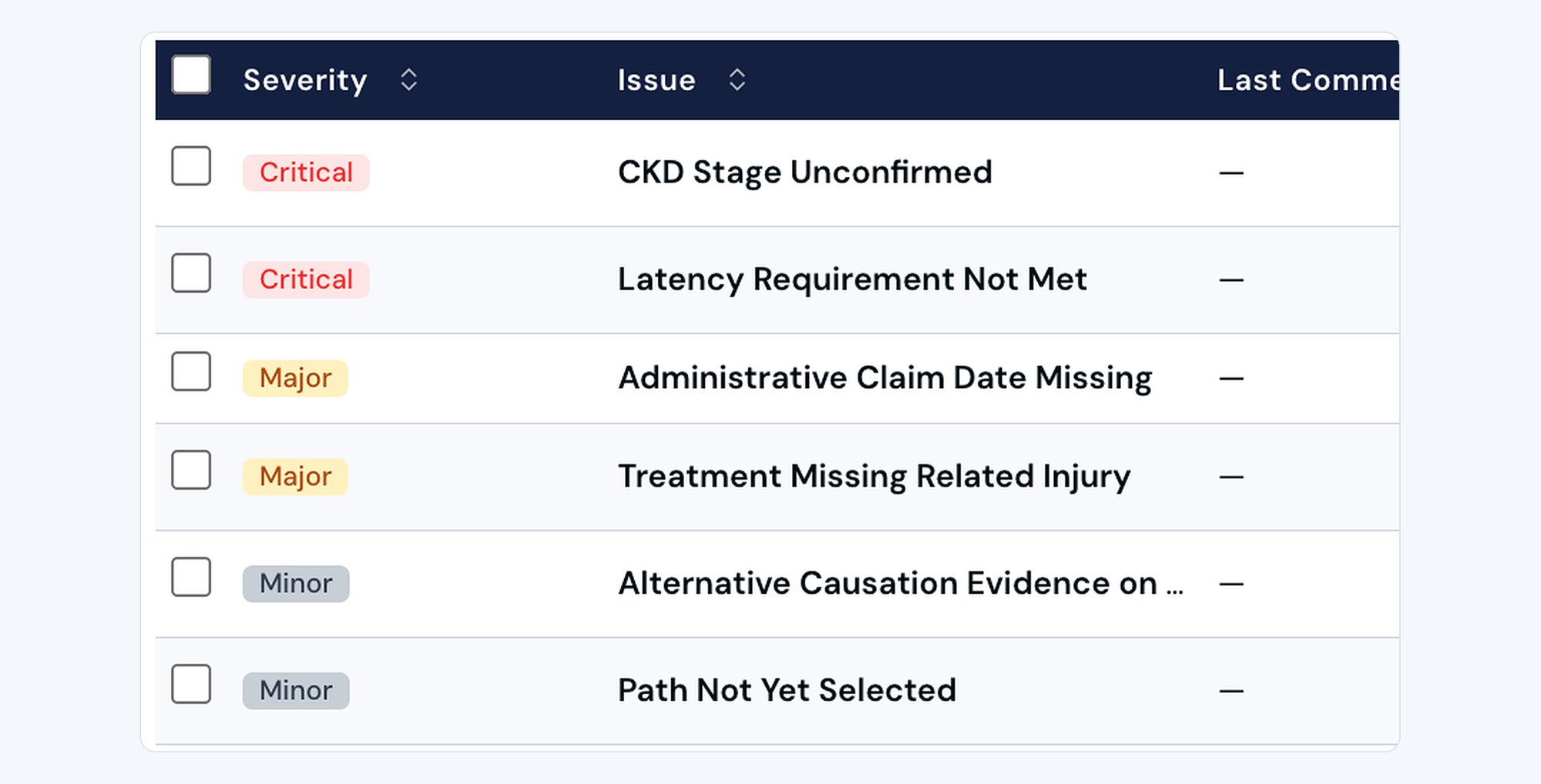
List of open items on a Camp Lejeune claimant ranked by severity
Open items, scored by severity

Open items sit inside each claimant profile and rank by severity: a missing exposure date, a latency gap, an unconfirmed CKD stage, an unresolved scleroderma form, incomplete death documentation. Reviewers see what needs attention and why, and the team decides what is worked first.
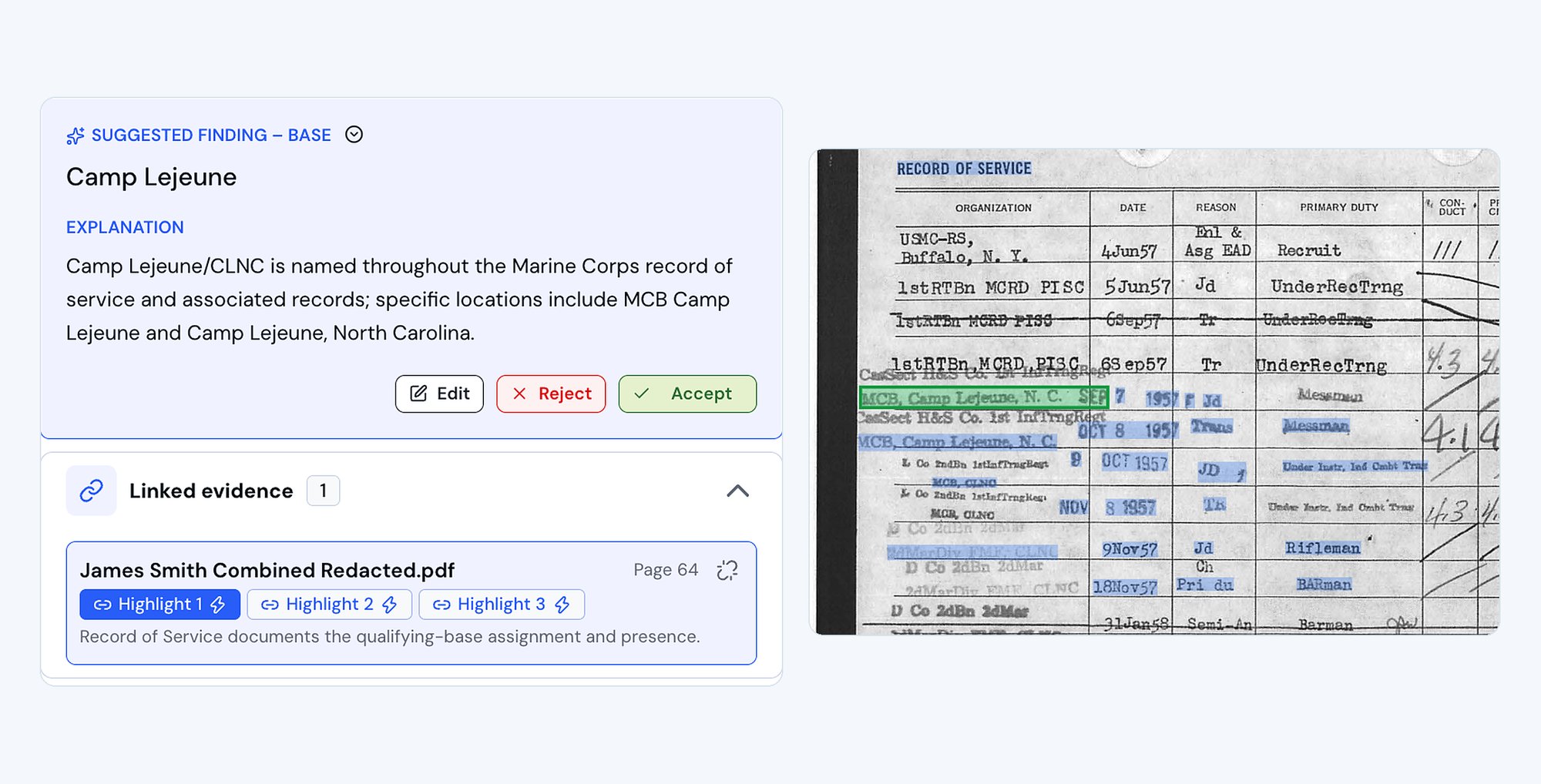
Extracted finding linked to the highlighted passage in the source record
Every field traced to its source

Each extracted value links back to the page in the record it came from, and can be relinked where the record supports a different read. Attorneys and reviewers validate against the source, and validated work carries forward.
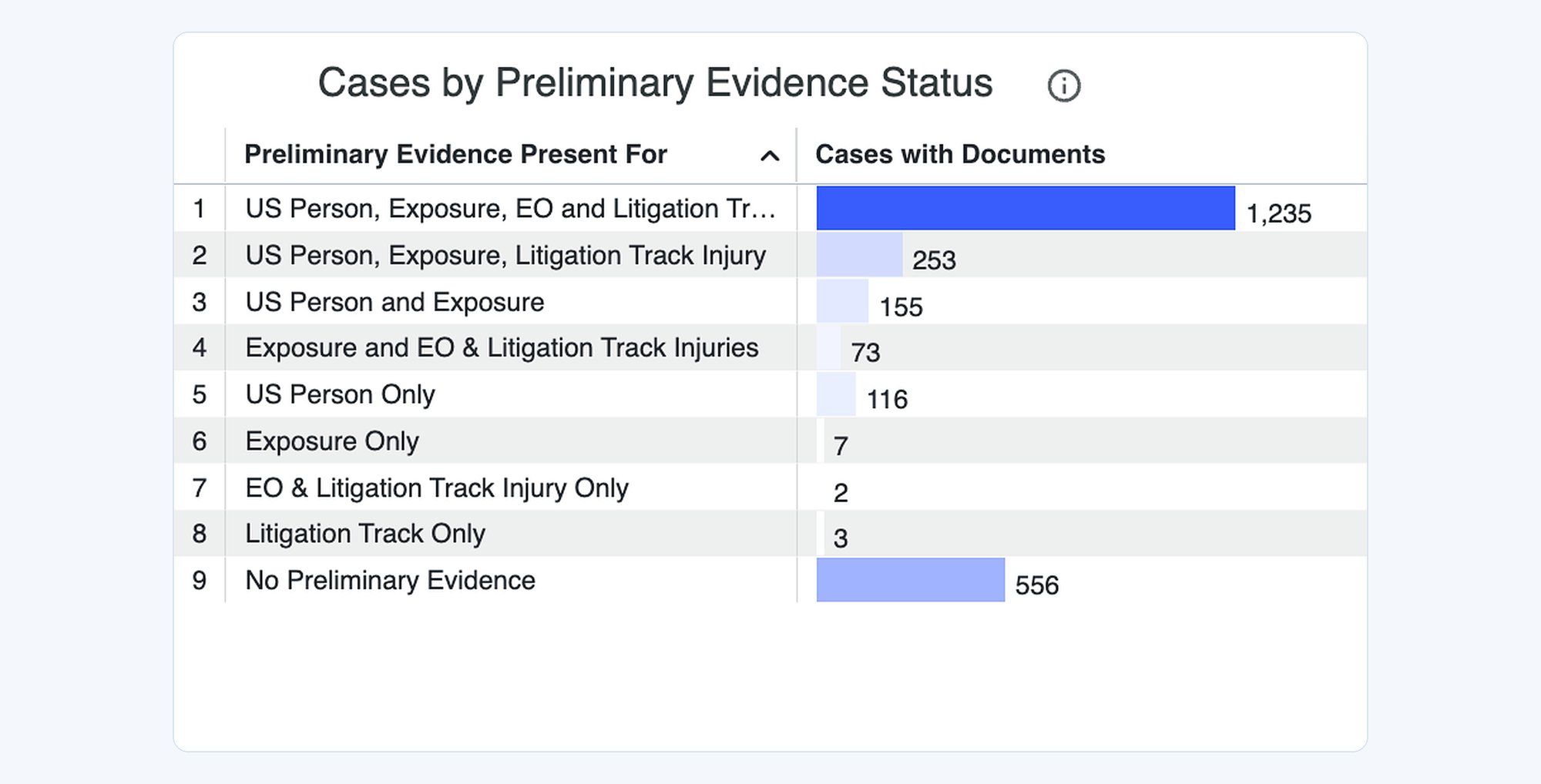
clj-inventory-status-HOLD-A@2x
Inventory status across the docket

Inventory status shows where the docket stands by exposure documentation, EO tier, and open items. Filter to the population you need and see where records are missing.

Frequently Asked Questions

What is the Camp Lejeune Justice Act litigation about?

The Camp Lejeune Justice Act of 2022 (CLJA), enacted as part of the Honoring Our PACT Act, allows individuals exposed to the water supply at Camp Lejeune and Marine Corps Air Station New River between August 1, 1953 and December 31, 1987 to seek relief from the United States. The water supply was contaminated with volatile organic compounds including trichloroethylene (TCE), tetrachloroethylene (PCE), vinyl chloride, and benzene. All CLJA lawsuits are consolidated in the Eastern District of North Carolina.

What are the two avenues of recovery in CLJ claims?

CLJ claimants have two distinct paths. The Elective Option (EO) is a government-administered fixed-payout program that pays by injury tier and cumulative exposure duration, from $100,000 to $450,000, plus a flat $100,000 where the death is linked to the qualifying injury, for a maximum of $550,000. The active federal litigation track offers no fixed compensation and proceeds on individualized damages. Accepting an EO offer waives the right to pursue the litigation track. Pattern holds both paths in a single case view, so each can be reviewed from the same record without rebuilding the case file.

What injuries qualify for the Elective Option?

The EO covers a defined list of conditions across two tiers. Tier 1 includes kidney cancer, liver cancer, non-Hodgkin's lymphoma, leukemia, bladder cancer, Parkinson's disease, and multiple myeloma. Tier 2 includes aplastic anemia and myelodysplastic syndromes, Stage 4–5 chronic kidney disease, and systemic scleroderma. Conditions outside this list can be pursued through the litigation track under the CLJA's "at least as likely as not" causation standard.

What is the latency window requirement and why does it create case complexity?

All CLJ injuries are subject to a two-sided latency window: diagnosis or first treatment must occur at least two years after first exposure and no more than 35 years after last exposure. For EO purposes, the injury must also have been diagnosed or treated before August 10, 2022. These three conditions must be validated per injury entry, not just at the case level. A claimant with multiple qualifying injuries may have one that passes the latency window and one that does not. Pattern validates all three conditions independently per injury and flags which one was missed.

What are the most common sources of EO case miscategorization?

Two conditions are regularly miscategorized. First, kidney disease: EO Tier 2 qualification requires Stage 4 or higher CKD specifically. A general kidney disease diagnosis or a Stage 3 entry does not qualify. Second, scleroderma: only systemic forms qualify under the EO. Localized scleroderma does not, but rheumatology records do not always specify the distinction clearly. Pattern captures CKD stage per injury entry and flags every scleroderma entry with a prompt to confirm systemic versus localized form before EO evaluation proceeds.

What documentation is required for exposure in CLJ claims?

For EO-track claimants, official documentation of base presence is required. Affidavits and sworn declarations are not sufficient. Accepted record types include DD-214 military discharge records, housing and base assignment records, VA records, financial records, and relationship documentation for dependent family members. Pattern captures record type per exposure entry and flags when the only available evidence is an affidavit, identifying which cases need official records before EO eligibility can be evaluated.

How does Pattern help firms prioritize Camp Lejeune cases?

Pattern ranks open items by severity inside each case and shows inventory status by exposure documentation and EO tier. Reviewers can see which cases need an official record, a staging confirmation, or a latency check, and the team sets the order of work. When criteria change, Pattern re-evaluates the whole inventory against the new standard, so no case starts over.

Request a demo.

See how Pattern works a Camp Lejeune case from exposure records to both recovery tracks, using cases like yours.