
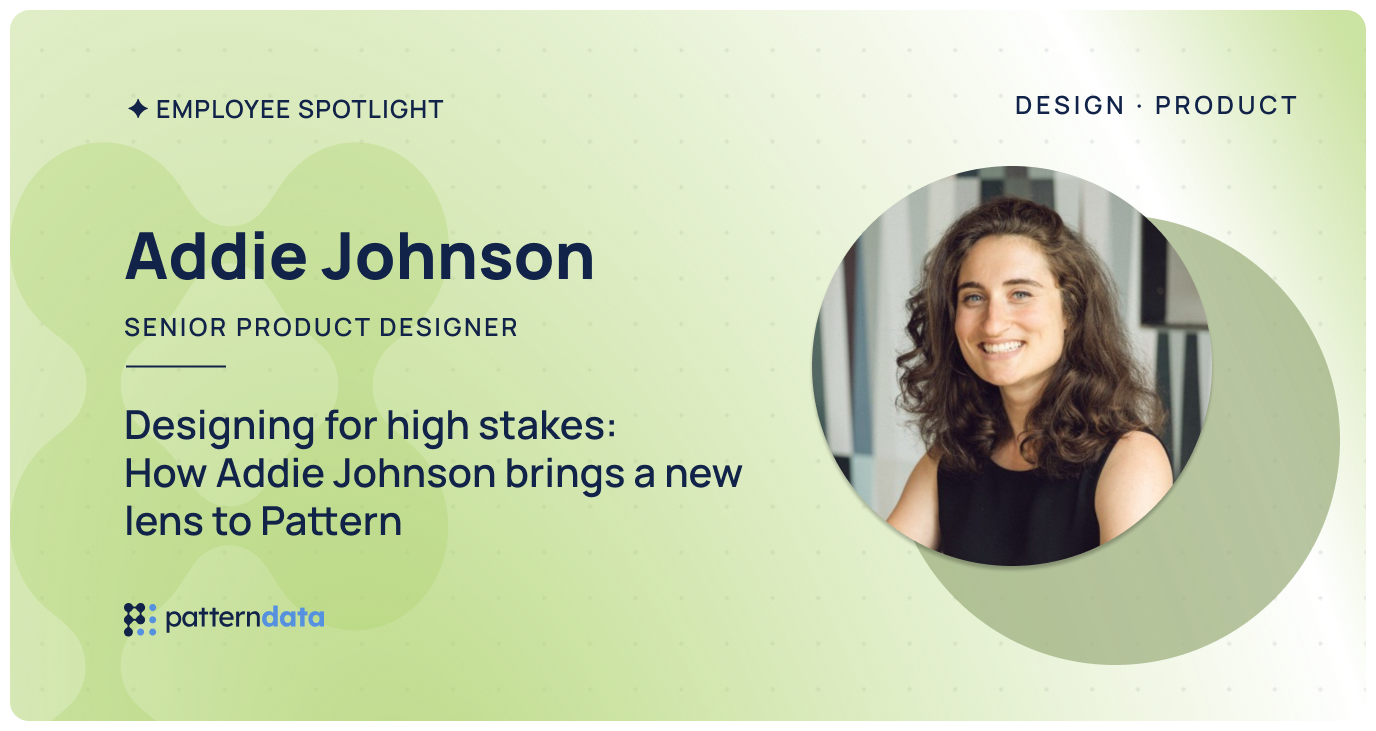
Mass tort litigation moves through enormous volumes of medical records, case files, and evidence. The people responsible for reviewing that information, paralegals, nurse reviewers, and litigation managers, spend their days inside software that either makes that work manageable or makes it harder. Every screen they see, every decision point in the platform, every moment where the system either helps someone move through a case or slows them down was designed by someone. Someone had to decide what information belongs on the surface, what lives a click deeper, and how to present AI-generated findings in a way that a busy reviewer can act on without second-guessing. That is all a part of Addie Johnson’s job.
Addie is Pattern’s first product designer. She is responsible for how attorneys, paralegals, and reviewers experience the platform from the moment they open a case to the moment they make a call on it.
She also starts with what breaks.
Most designers think about the happy path first. Addie thinks about what happens when the data is missing, when someone moves too fast, when the system does not behave the way the user expects. That instinct comes directly from her time in quality assurance, and it shapes every design decision she makes at Pattern.
A path that does not follow a straight line
Addie started in graphic design, moved into quality assurance on a friend’s recommendation, then circled back to design with a new way of seeing things.
“The QA part of my career shaped me the most,” she says. “It taught me to think in edge cases before the happy path.”
That combination is rare. Most designers come up through visual or interaction design. Addie came up through that too, but she also spent time in the weeds of how software actually breaks. She learned to write acceptance criteria, anticipate error states, and think about what happens when a user moves too fast or the data is missing. That background now shapes how she approaches every design decision she makes at Pattern.
“The graphic design background lends a strong opinion about visual logic and hierarchy,” she says. “What our eyes do. And explaining things as a system that can hold together under pressure.”
A different kind of user
Coming from CarMax, where Addie could email thirty customers a week for user testing, the shift to legal technology required a different approach entirely.
“Discovery is much harder with B2B, specifically in the legal technology space,” she says. “Now it is a little bit more challenging since we can’t always talk to our reviewers.”
At Pattern, the users are nurse reviewers, paralegals, and litigation managers working under real time pressure. They are not signing up for lengthy research sessions. So Addie has had to rethink what discovery even looks like.
Part of that shift has been changing what she looks for. She watches session recordings in Pendo, a product analytics tool that captures how users actually move through the product, and looks for signals that the information hierarchy does not match how someone thinks about a case. If a reviewer is scanning in the wrong order, that tells her something.
“We have to get really comfortable with really short and targeted touch points,” she says. “Since they are domain experts, I am less focused on whether they can complete a task and more focused on whether the mental model is correct.”
The problem she is most excited about
Right now, Addie is focused on one of the harder design problems in the platform.
“We have AI making judgment calls that affect real case outcomes,” she says. “Helping reviewers understand where that information came from and why the system placed it where it did is really crucial to the product. Not just a confidence score, but what the model was weighing, what it was not sure about, and what to look for if you want to verify it.”
Making AI reasoning legible without overwhelming the review flow is, as she puts it, a really exciting problem.
Reviewers working through large volumes of cases need to move fast. But speed without understanding creates risk. Addie is working on how to give reviewers both: the ability to trust the system and the ability to verify it when something does not look right.
Coffee, culture, and a team ritual
Addie is based in Richmond, where several members of the Pattern team share office space. One of the things she has come to appreciate most is a standing Tuesday coffee ritual, where Koleman Nix, Pattern’s CTO, and William, a software engineer on the team, make pour overs for whoever is in.
“It is just a lovely way to slow down and enjoy and meet everyone from a more personal level,” she says.
The coffee thread runs deeper across the company. Misha, one of Pattern’s AI analysts, built a shared coffee passport where team members log tasting notes and ratings regardless of where they are working from. Addie keeps hers updated whether she is in the office for the Tuesday ritual or making it herself at home.
Learning a new world
Addie is a little over a month into the role, and she is characteristically direct about what she knows and what she is still building.
“The more that I learn, sometimes the more I realize I do not know,” she says.
To get up to speed, she has been reading about mass tort litigation from multiple angles, including books recommended by colleagues, and the user flows and service blueprints she is building as part of her day-to-day work. Each layer adds context. The legal procedural side, multidistrict litigation, what attorneys actually care about, she describes it as a domain that rewards patience.
“It is just a really deep domain,” she says. She has also been leaning into Pattern’s client success team, who work directly with law firms day to day, to fill in the gaps she cannot get from reading alone.
Every firm that opens Pattern is making decisions based on what they can see. Addie is the person making sure what they see is the right thing, presented in the right way, at the right moment. That work is quiet by design. When she does it well, the platform just feels like it works.