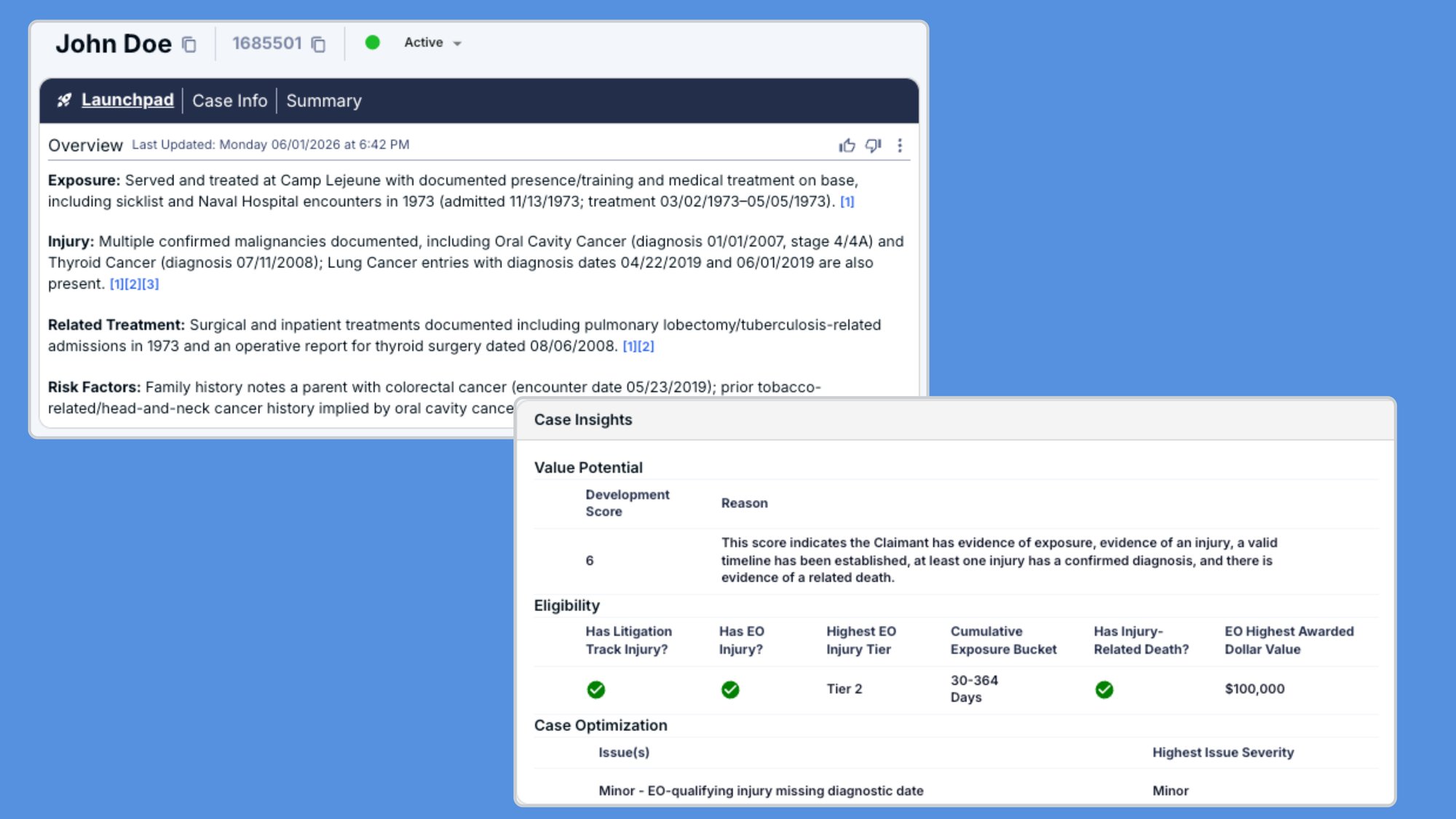
Exposure Verification
Accelerate medical review

Military service records, DD-214s, housing records, VA records, and financial records. Cumulative exposure days calculated, EO duration tiers applied, and affidavit-only exposure flagged automatically.

Injury Documentation

EO tier assigned per injury across Tier 1 and Tier 2 conditions. Latency window validated per injury entry. CKD staging confirmed. Scleroderma form distinguished. Evidence strength classified by record type.

Risk Factors and Defense Data

Alcohol history, smoking and vaping history, family history, and drug usage captured per claimant. Each risk factor evaluated against the earliest injury date. Causation vulnerabilities surfaced before deposition.

Dual-Track Recovery Evaluation

EO compensation calculated based on injury tier, exposure duration, and death enhancement. Litigation-track treatment severity captured simultaneously. Both paths evaluated from a single case view, without toggling between systems.
Settlement criteria for Camp Lejeune cases.

Ensure each Camp Lejeune case meets settlement criteria with thorough documentation and data-driven valuation adjustments.

DoD Service Records and DD-214s
Exposure dates and cumulative duration
EO duration tier placement
Qualifying injury and EO tier
Diagnosis dates and latency compliance
CKD staging documentation
Systemic vs. localized scleroderma
Treatment history and severity
Risk factors and causation data
Death documentation and EO enhancement
Copy Score and prioritize
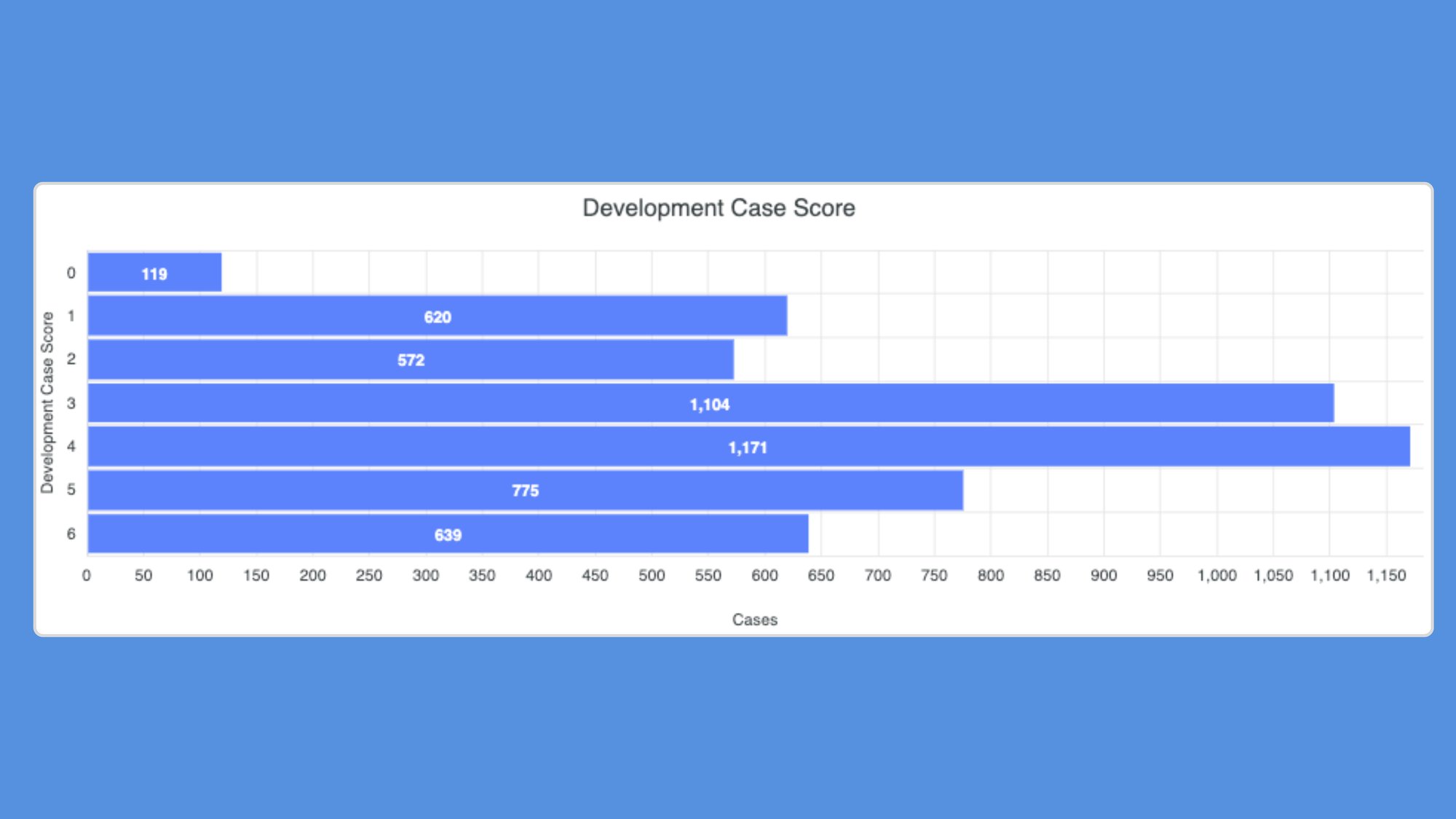
Score and prioritize your entire docket

Every CLJ claimant receives a Development Case Score  based on the strength of their evidentiary record. Firms can rank their entire inventory in seconds, identifying their strongest cases, surfacing cases that need one additional record to move up, and making informed decisions about which claims to advance first.
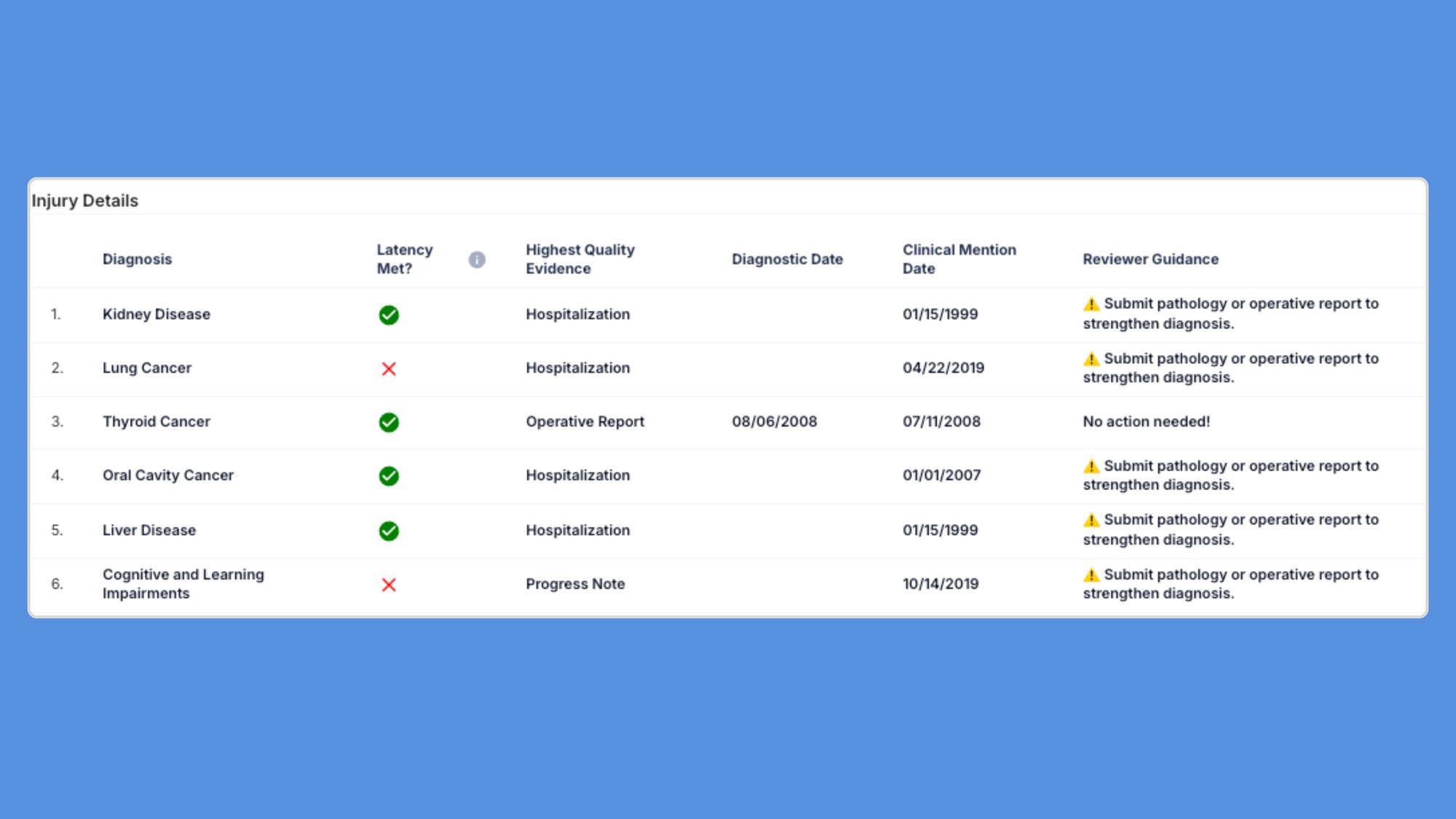
Reviewer guidance built into every profile

Pattern surfaces contextual flags directly within each claimant profile, including missing exposure dates, latency violations, CKD staging gaps, scleroderma form confirmation, and incomplete death documentation, so reviewers always know what needs attention and why.
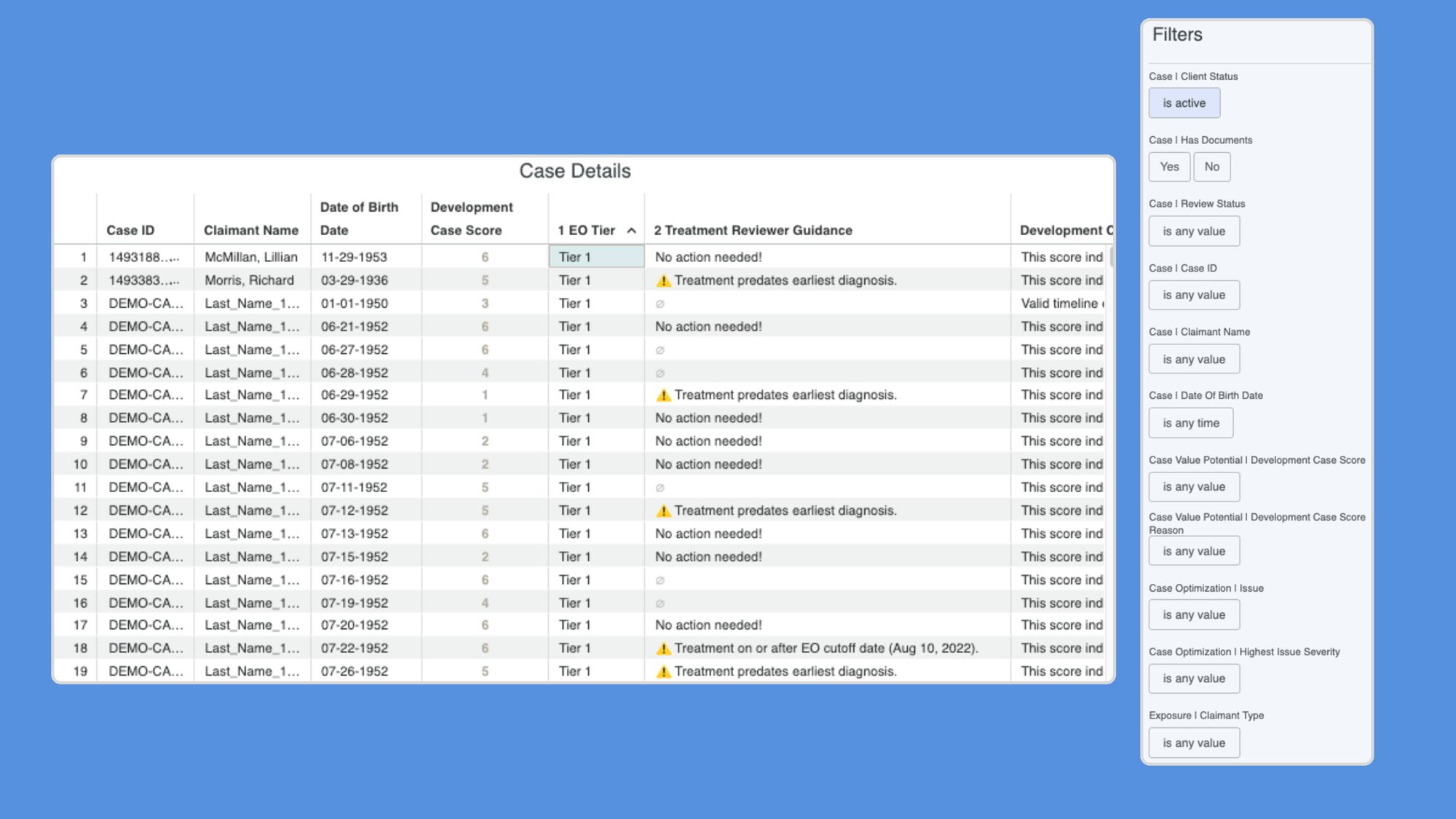
CLJ Inventory with filters
Understand your CLJ inventory instantly

Interactive dashboards show case distribution by score, EO tier, exposure duration, and documentation status across your full docket. Filter to exactly the population you need and identify where to focus resources before key litigation milestones.

CLJ Export (1)
Generate claimant work product

Export structured case data including development scores, EO eligibility determinations, and supporting documentation in a format ready for attorney review and EO offer evaluation, individually or in bulk.

How law firms use pattern data.

Mass transfer records for fast analysis

Process large caseloads quickly using our advanced data processing, tailored specifically for Camp Lejeune litigation.

Advanced OCR technology

Convert unstructured medical data into structured, actionable information tailored to Camp Lejeune settlement criteria.

Automated recalculations

Easily adapt to new settlement criteria or injury updates with our system’s automated recalculations and export features.

Seamless integration and customization

Integrate with existing processes seamlessly, using customizable scripts, automated actions, and workflow settings to optimize efficiency.

Frequently Asked Questions

What is the Camp Lejeune Justice Act litigation about?

The Camp Lejeune Justice Act of 2022 (CLJA), signed as part of the Honoring Our PACT Act, created the first legal right for individuals to sue the federal government for injuries caused by decades of toxic water contamination at Camp Lejeune and Marine Corps Air Station New River. Between 1953 and 1987, the water supply was contaminated with volatile organic compounds including trichloroethylene (TCE), tetrachloroethylene (PCE), vinyl chloride, and benzene at levels far exceeding safe exposure thresholds. Over 500,000 administrative claims were filed before the August 2024 deadline. All CLJA lawsuits are consolidated in the Eastern District of North Carolina.

What are the two avenues of recovery in CLJ claims?

CLJ claimants have two distinct paths. The Elective Option (EO) is a government-administered fixed-payout program that pays based on injury tier and cumulative exposure duration, with a maximum payout of $550,000. The active federal litigation track offers no fixed compensation but allows claimants to pursue individualized damages. Accepting an EO offer waives the right to pursue the litigation track. Pattern evaluates both paths simultaneously from a single case view, so firms can counsel clients on the tradeoff without rebuilding the case file.

What injuries qualify for the Elective Option?

The EO covers nine conditions across two tiers. Tier 1 — the highest-value category — includes kidney cancer, liver cancer, non-Hodgkin's lymphoma, leukemia, bladder cancer, Parkinson's disease, and multiple myeloma. Tier 2 includes aplastic anemia and myelodysplastic syndromes, Stage 4–5 chronic kidney disease, and systemic scleroderma. Conditions outside these nine can be pursued through the litigation track under the CLJA's broader "at least as likely as not" causation standard.

What is the latency window requirement and why does it create case complexity?

All CLJ injuries are subject to a two-sided latency window: diagnosis or first treatment must occur at least two years after first exposure and no more than 35 years after last exposure. For EO purposes, the injury must also have been diagnosed or treated before August 10, 2022. These three conditions must be validated per injury entry — not just at the case level. A claimant with multiple qualifying injuries may have one that passes the latency window and one that does not. Pattern validates all three conditions independently per injury and flags the specific disqualifying condition when any window is missed.

What are the most common sources of EO case miscategorization?

Two conditions are regularly miscategorized. First, kidney disease: EO Tier 2 qualification requires Stage 4 or higher CKD specifically. A general kidney disease diagnosis or a Stage 3 entry does not qualify. Second, scleroderma: only systemic forms qualify under the EO. Localized scleroderma does not, but rheumatology records do not always specify the distinction clearly. Pattern captures CKD stage per injury entry and flags every scleroderma entry with a prompt to confirm systemic versus localized form before EO evaluation proceeds.

What documentation is required for exposure in CLJ claims?

For EO-track claimants, official documentation of base presence is required — affidavits and sworn declarations are not sufficient. Accepted record types include DD-214 military discharge records, housing and base assignment records, VA records, financial records, and relationship documentation for dependent family members. Pattern captures record type per exposure entry and flags when the only available evidence is an affidavit, giving firms clear visibility into which cases need official records before an EO offer can be evaluated.

How does Pattern help firms prioritize CLJ cases before settlement criteria are finalized?

Every CLJ claimant receives a Pattern Development Case Score on a 0–6 scale based on the strength of their evidentiary record — exposure validity, injury confirmation, timeline integrity, treatment severity, and death documentation. The score is independent of formal EO eligibility. It gives firms a consistent case strength signal across the entire inventory today, before global litigation-track settlement criteria are announced and before resources are committed to cases that won't hold up.

Request a Demo.

Interested in learning more? Fill out the form to request a demo.