
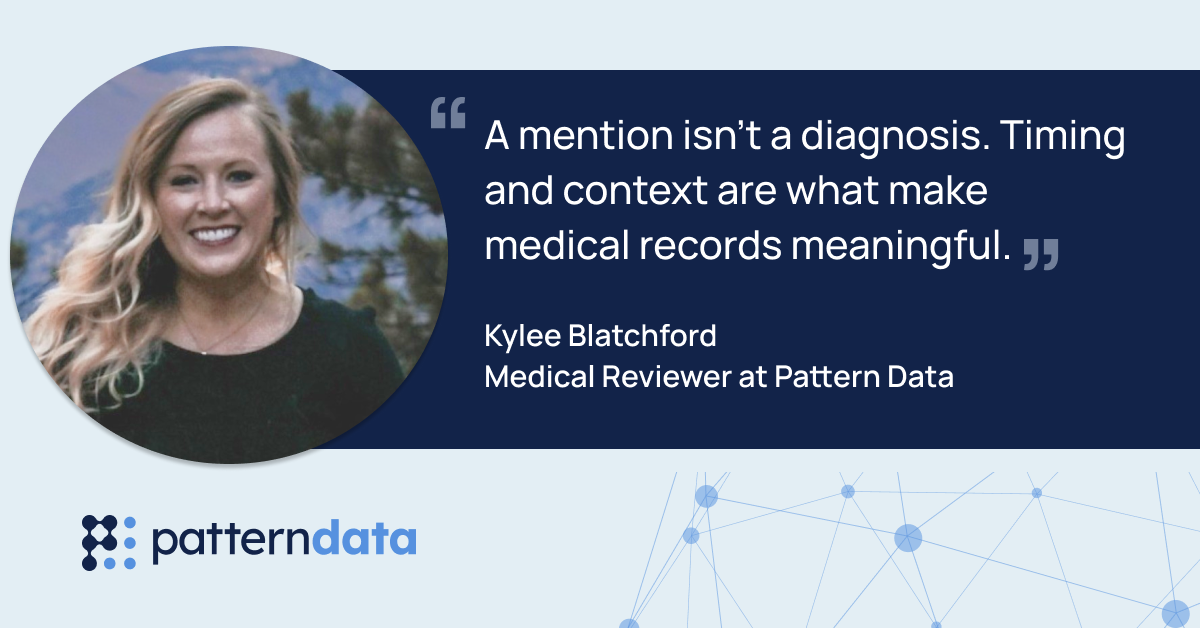
Kylee Blatchford learned early in her career that medical records rarely tell a clean story.
Before joining Pattern, she worked in healthcare and clinical research, running oncology trials and supporting patients through complex treatment plans, often working directly with people navigating serious illness. Her role required constant interaction with medical records. She screened patients for eligibility, reviewed medical histories, coordinated care, and ensured every detail aligned with strict clinical protocols.
“You really can’t miss anything,” Kylee says. “If something’s wrong, it gets caught later, and it affects real people.”
Learning How to Read Records Carefully
In clinical research, eligibility decisions depended on close and careful review. Patients had to meet specific criteria, and those determinations relied on understanding what the records actually showed.
Information was often scattered across providers. Symptoms appeared before diagnoses. Notes conflicted or repeated each other. A single mention of a condition did not always indicate a confirmed diagnosis, and a diagnosis alone did not always qualify a patient for a trial.
“You’re trying to understand what actually happened,” Kylee explains, “not just what’s written in one place.”
Over time, she became comfortable reviewing large volumes of records and making decisions based on context, not assumptions. That experience shaped how she approaches medical review today.
Finding Familiar Work in an Unexpected Place
When Kylee began thinking about her next step, she expected to stay within healthcare. She considered administrative and insurance roles where medical record review was common.
Pattern challenged that expectation.
What stood out was not the technology itself, but the focus on medical records and criteria-based review. The setting was new, but the work felt familiar.
“It was basically what I had been doing,” she says, “just applied differently.”
Applying Medical Judgment at Pattern
At Pattern, Kylee’s work focuses on defining how medical records are analyzed and reviewed, before cases ever reach firm teams. She contributes clinical expertise to help shape medical review criteria litigation by litigation, while also reviewing cases as part of quality assurance and supporting nurse reviewers and litigation teams when questions arise.
As part of a cross-functional team, Kylee works alongside litigation managers and analysts to research each litigation and determine which medical concepts are most relevant. That includes identifying qualifying injuries, treatments, medications, diagnostic criteria, and, in some cases, genetic or risk factors. Just as important is understanding what should not be included, information that may appear in records but would only add noise or confusion.
“There’s a lot that can show up in medical records that looks relevant on the surface but isn’t,” Kylee explains. “Part of the job is making sure we’re focusing on what actually matters for that litigation.”
Once those criteria are defined, Kylee helps translate that medical judgment into litigation-specific detection logic within Pattern’s platform. That logic guides what the system looks for across medical records, accounting for diagnoses, related variants, symptoms, medications, and common synonyms, while also intentionally excluding information that could muddy the picture.
Kylee also helps oversee internal quality assurance, working with nurse reviewers to test and validate medical review logic before it reaches firm teams. That process helps surface inconsistencies early and ensures firm teams are reviewing work that has already been carefully validated.
For Kylee, the goal is consistency without oversimplification, ensuring that review starts from a medically sound foundation and remains aligned with the realities of how conditions are documented in real-world patient care.
Why Context Still Matters
Kylee is clear that speed alone is not the goal. Medical records often lack straightforward answers, and reviewing them without context can lead to incorrect conclusions.
In healthcare, those mistakes affect patient eligibility and care. In litigation, they affect how cases are evaluated and developed.
Her work helps ensure that medical review remains grounded in what the records actually support, even as the process becomes more efficient.
A Role She Did Not Expect
Earlier in her career, Kylee did not imagine herself working on an AI team. While the technology was unfamiliar at first, the collaboration felt natural.
“It’s been interesting to see how medical experience fits into this kind of work,” she says.
What has not changed is her focus. Accuracy still matters. Careful interpretation still matters. And decisions still depend on understanding the full medical picture.
At Pattern, Kylee brings that perspective into scaled review, helping ensure that medical judgment remains part of the process as volume grows.