

How Ryan Schmitt turns inconsistent records into defensible AI
Author: Ashley Grodnitzky
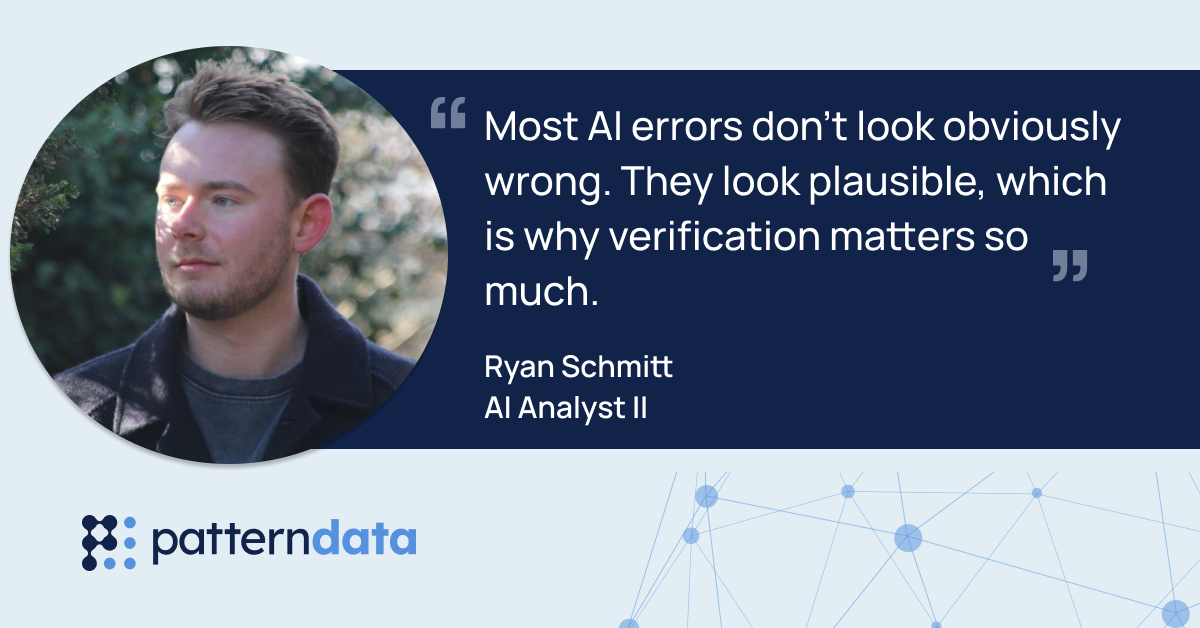
Applying a scientific approach to translate messy medical records into defensible criteria
Ryan Schmitt’s path to Pattern began with a realization that reshaped his career plans. While completing his degree in neuroscience and preparing for graduate school, he began experimenting with early large language models and quickly recognized their potential to change how complex information is processed.
He paused his graduate applications and spent his final year of school learning everything he could about generative AI and generative AI and machine learning. He was drawn to the idea of replacing manual, error-prone work with systems that could reason at scale. That focus ultimately led him to Pattern as the company’s first AI Analyst, where he now applies a scientific mindset to some of the most complex data challenges in mass tort litigation.
Quantifying Inconsistency to Build Reliability
The transition from the lab to Pattern was driven by an early understanding of where manual processes reach their limits. During his time in neuroscience research, Ryan and a team of assistants watched four-hour videos of children performing what he describes as “aggressively boring” schoolwork while wearing brain wave scanners. Ryan’s job was to note every body movement, such as a head shift or fidget, that could affect the data.
He quickly noticed a fundamental problem. Each reviewer had a different opinion about what constituted a meaningful movement. To address this, Ryan developed an algorithm to quantify where judgments diverged and help the team reach consensus.
That experience shaped how Ryan thinks about review at scale. The same variability appears in mass tort litigation, where thousands of records are evaluated under evolving criteria and small differences in interpretation can meaningfully affect outcomes.
Translating Chaotic Data into Logical Workflows
At Pattern, Ryan focuses on configuring large language models to navigate the complexities of unstructured medical records. Unlike standardized datasets, medical documentation varies widely across providers, time periods, and formats, with little consistency in how information is recorded.
Ryan’s work includes defining detection logic, testing edge cases, and refining how litigation-specific criteria are translated into model behavior. Rather than searching for a single technical solution, the team embeds litigation knowledge directly into the system so it can understand context, not just keywords.
His role has been central to Pattern’s evolution, from early document extraction experiments to the sophisticated litigation lenses used today to identify evidence of injury or exposure across large case inventories.
Refining Defensibility in Mass Torts
In many technical fields, 90 percent accuracy is considered a success. Ryan knows that in a legal context, the remaining 10 percent can materially change outcomes depending on what information is missed.
The challenge is not just improving accuracy overall, but identifying which outliers introduce the most risk and addressing them through targeted testing. Today, Ryan works closely with cross-functional teams that include litigation managers, medical experts, and nurse reviewers to push accuracy toward 99 percent in critical areas.
This human-in-the-loop approach ensures that AI provides speed and scale, while clearly defined logic and expert validation deliver the defensibility required for litigation and settlement decisions.
Precision Through Continuous Improvement
With more than 5,000 hours spent working directly with these systems, Ryan has developed a clear intuition for how AI models fail and how to correct them. He approaches the work with a focus on precision, ensuring that small daily improvements compound over time.
“By the end of the day, the system should be better than when we started,” he says.
At Pattern, that mindset helps transform fragmented medical records into evidence legal teams can trust. It gives firms clearer answers, stronger cases, and a more defensible path through complex mass tort litigation.


back to all news